

Today, we wrap up our three-week exploration of generosity. We’ve spent time dwelling in God’s generosity, reflecting on how throughout Scripture, a rhythm repeats: God loves, so God gives.
We’ve also taken a look at God’s invitation to us, to come and join the party, to participate in God’s generous giving.
Today, we’re going to dive deep and think about generosity as a spiritual practice – not just an end unto itself, but an exercise that has tangible benefits for us: deepening our faith and strengthening our communities.
Our second reading comes from the middle of 2 Corinthians. We’re zooming in on a little piece of a larger conversation, so let me give us some context.
The apostle Paul founded the church in Corinth, and he kept in touch with them pretty extensively as he traveled throughout what we now know as Greece and Turkey. One of the projects he worked on as he traveled was a special offering from those “western” churches, which would go to Christians in Jerusalem who were in need. In this section of the letter, he’s encouraging the Corinthian church to participate in this offering – not twisting their arms, but reminding them of the cycle of grace, gratitude, and generosity that God ignites when we come to know how wide, and deep, and long God’s love for us truly is.
I don’t usually do this, but I’m going to read from a paraphrase version today – The Message, by Eugene Peterson – because I want us to get a sense of the emotional landscape of this invitation to generosity.
Scripture: 2 Corinthians 9:6-15 (The Message)
Remember: A stingy planter gets a stingy crop; a lavish planter gets a lavish crop. I want each of you to take plenty of time to think it over, and make up your own mind what you will give. That will protect you against sob stories and arm-twisting. God loves it when the giver delights in the giving.
God can pour on the blessings in astonishing ways so that you’re ready for anything and everything, more than just ready to do what needs to be done. As one psalmist puts it,
He throws caution to the winds,
giving to the needy in reckless abandon.
His right-living, right-giving ways
never run out, never wear out.
This most generous God who gives seed to the farmer that becomes bread for your meals is more than extravagant with you. He gives you something you can then give away, which grows into full-formed lives, robust in God, wealthy in every way, so that you can be generous in every way, producing with us great praise to God.
Carrying out this social relief work involves far more than helping meet the bare needs of poor Christians. It also produces abundant and bountiful thanksgivings to God. This relief offering is a prod to live at your very best, showing your gratitude to God by being openly obedient to the plain meaning of the Message of Christ. You show your gratitude through your generous offerings to your needy brothers and sisters, and really toward everyone. Meanwhile, moved by the extravagance of God in your lives, they’ll respond by praying for you in passionate intercession for whatever you need. Thank God for this gift, his gift. No language can praise it enough!
We are busy people in a busy world. It’s a world that’s drowning in information and so many of our spaces are designed down to the millimeter to shout for our attention. Just on the car ride here today, there were potentially a dozen different forms of advertising on display: radio ads, billboards, yard signs, flashing neon business signs, helpful suggestions for nearby restaurants from your GPS app or Facebook, a notification on your phone reminding you that you still have $4 to spend on that Starbucks gift card, fifteen flyers in your mailbox and another 12 in your email telling you what’s on sale this week, and another 3 letters asking for financial support for a charity you donated to once five years ago.
Humans aren’t designed to take in all of that at once, so we learn to build a buffer zone, to develop a thick skin, to filter out just the information we need. We glance briefly at the ads before throwing them in the recycle bin. We mass-delete emails. We tune out all the signs and banners and billboards. We skim the paper. We do or think about other things during commercials – except during the Super Bowl, of course.
And then, we come and we sit and hear Paul’s invitation to giving. For some of us, I’m sure it feels like one more ask in a long line of asks coming from every direction.
But while the world is demanding more from us – more attention, more flash, more money, higher standards, better this, just one more that – Paul is speaking the language of freedom and extravagance.
A lavish planter gets a lavish crop.
God loves it when the giver delights in the giving.
God can pour out the blessings in astonishing ways.
Generous. Extravagant. Wealthy. Great praise. Abundant and bountiful thanksgivings.
Don’t get me wrong. I’m not here to sell you the idea that if you give more, you’ll automatically get more, like some sort of church ponzi scheme. I am not selling you “double your money in 30 days or less!”
The return on this kind of investment isn’t monetary, and it’s more than simply knowing you’ve helped – what the Spirit grows in us when we give is gratitude, joy, and community.
Elizabeth Dunn is a psychology professor at the University of British Columbia, and the focus of her research is happiness – and how humans can use our time, money, and technology to invest in happiness. She’s also the co-author of Happy Money: The Science of Happier Spending.
What she’s discovered in her research is that humans are hard-wired to enjoy being generous. As she says in a TEDx talk from April 2019: “When we analyzed surveys from more than 200,000 adults across the globe, we saw that nearly a third of the world’s population reported giving at least some money to charity in the past month. Remarkably, in every major region of the world, people who gave money to charity were happier than those who did not, even after taking into account their own personal financial situation. And this correlation wasn’t trivial. It looked like giving to charity made about the same difference for happiness as having twice as much income.”
Science backs up what Paul knew in his bones: that generous giving leads us into that feeling of abundance – not the other way around. We do not think our way into a new way of living as much as we live our way into a new way of thinking.
But there’s more. She goes on to talk about the importance of human connection in our generosity.
“…in one experiment, we gave participants an opportunity to donate a bit of money to either UNICEF or Spread the Net. We chose these charities intentionally, because they were partners and shared the same critically important goal of promoting children’s health. But I think UNICEF is just such a big, broad charity that it can be a little hard to envision how your own small donation will make a difference.
In contrast, Spread the Net offers donors a concrete promise: for every 10 dollars donated, they provide one bed net to protect a child from malaria.
We saw that the more money people gave to Spread the Net, the happier they reported feeling afterward. In contrast, this emotional return on investment was completely eliminated when people gave money to UNICEF. So this suggests that just giving money to a worthwhile charity isn’t always enough. You need to be able to envision how, exactly, your dollars are going to make a difference.”
We know this, even if we didn’t know this. It’s why the Mission Team does such a fantastic job setting up opportunities for us to give throughout the year, like Stuff the Bus school supply drive and Harvest Bags Thanksgiving food drive.
When we show up with backpacks and crayons, we can see in our minds eye a kid on their first day of school, taking that smiling front porch picture with all the supplies they need.
When we bring a bag full of paper towels, stuffing mix and pie filling, we can easily envision a family gathered around a table for a warm Thanksgiving meal.
And this idea that our small contributions can make a tangible difference is important here. When our giving is combined, when the pop top tabs for Ronald McDonald house are all tallied, when the snack bags for Hand2Hand are all piled up, we get to see the power of being generous together. In the face of overwhelming need, we get a real-time look at the abundance, the extravagance of God that Paul talks about.
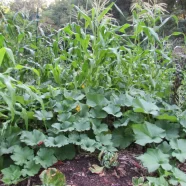
Where are my gardeners? Who’s heard of companion planting?
Companion planting is a specific way of organizing a garden so that specific plants can help one another grow. One of the most well-known companion planting methods is a Native American planting called the Three Sisters: corn, pole beans, and squash.
Instead of planting individual plants in individual rows, you plant one of each vegetable in the same space. The corn grows tall and sturdy, and the pole beans use the corn stalk as their support beam. Meanwhile, the pole beans draw nitrogen out of the air and bring it down into the soil, acting as a natural fertilizer. At the same time, the large leaves of the squash vines growing along the ground offer shade to the soil like a natural mulch, keeping it moist and cool. The prickly leaves also keep pests like raccoons away. The beans wind their way through all the vines and stalks, holding everything together.
When we practice generosity – intentionally, faithfully, regularly – we will also see virtues like gratitude and joy and community growing alongside it, weaving together like the three sisters. This is the power of generosity.
Knowing this, I want to invite you one more time to find the card in your bulletin, which contains a question: which acts of generosity here at Parkwood have brought you joy, or made you proud? You’re invited to fill it out, and drop it in the offering plate or leave it in the basket behind the last row of chairs, and we’ll display them along with the rest of the cards from this stewardship season in the back, so we can share the joy.
Beloved people of God, here is the good news: God’s love is constantly flowing from the heart of God into our lives in real, tangible ways – and beyond simply giving to us, God invites us to be active participants in that generosity as it flows out into the world, to experience the joy of giving ourselves. And even then, the fruits of generosity do not end with the gift, as with every gift the Holy Spirit cultivates deeper love, stronger communities, broader gratitude, and greater joy.
Thanks be to God. Amen.
Source: TEDx talk by Elizabeth Dunn: https://www.ted.com/dubbing/elizabeth_dunn_helping_others_makes_us_happier_but_it_matters_how_we_do_it/transcript?audio=en&language=en